


Transition Intelligence™

Change can make sense on paper and still feel difficult from the inside.
A new role. A restructure. A shift in expectations. A personal transition. A strategy that is right, necessary, often chosen. And still, something lags behind. Relationships strain. Familiar ways of being fall away before new ones have properly taken root.
Transition Intelligence™ is a psychologically informed framework for working with that human reality - so that change, even when it is chosen, can actually take root. It is relevant wherever that change is being lived: by an individual, a team, or a wider organisation.
The two faces of change
Change has two faces.
One is about what is beginning: the opportunity, the future, the vision taking shape. The other is about what must be left behind: familiar ways of working, established identities, sources of confidence, relationships, routines, and the sense of certainty people once relied on.
Most change efforts focus heavily on the first and move too quickly past the second.
Transition Intelligence™ works with both.
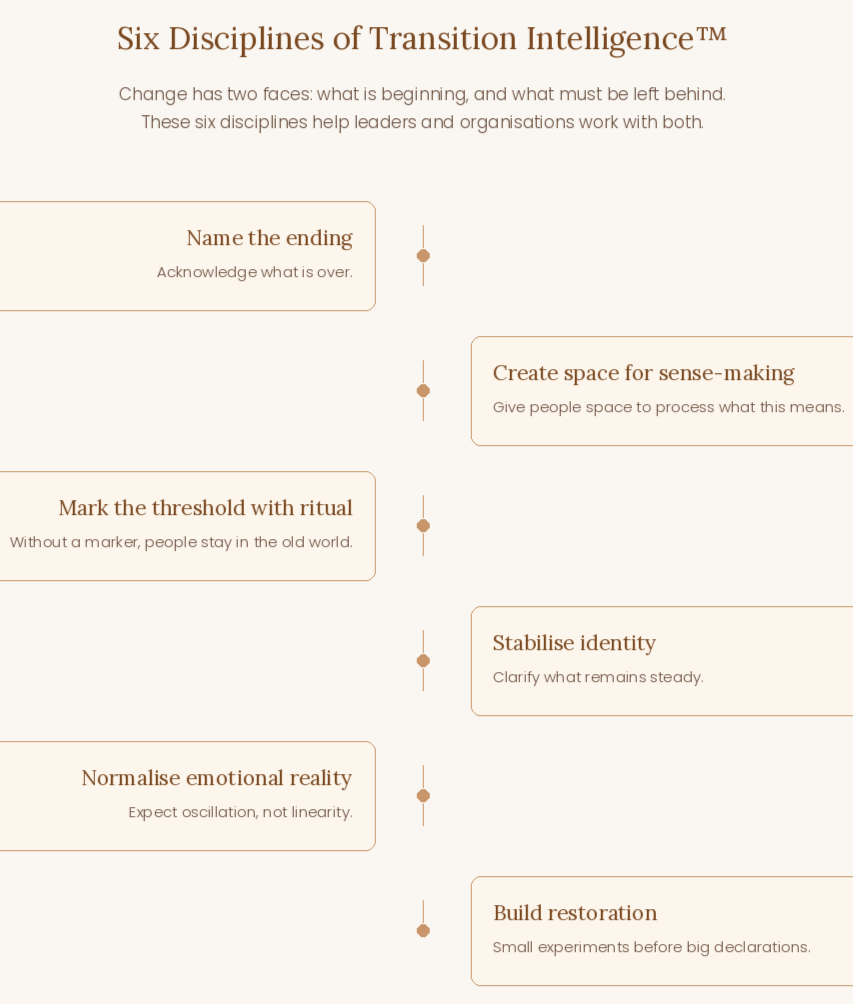
Six Disciplines of Transition Intelligence™
Six disciplines help individuals, teams, and organisations move through change with greater clarity, integrity, and realism.
They do not describe a rigid sequence. They point to the conditions that make transition more workable and more sustainable.
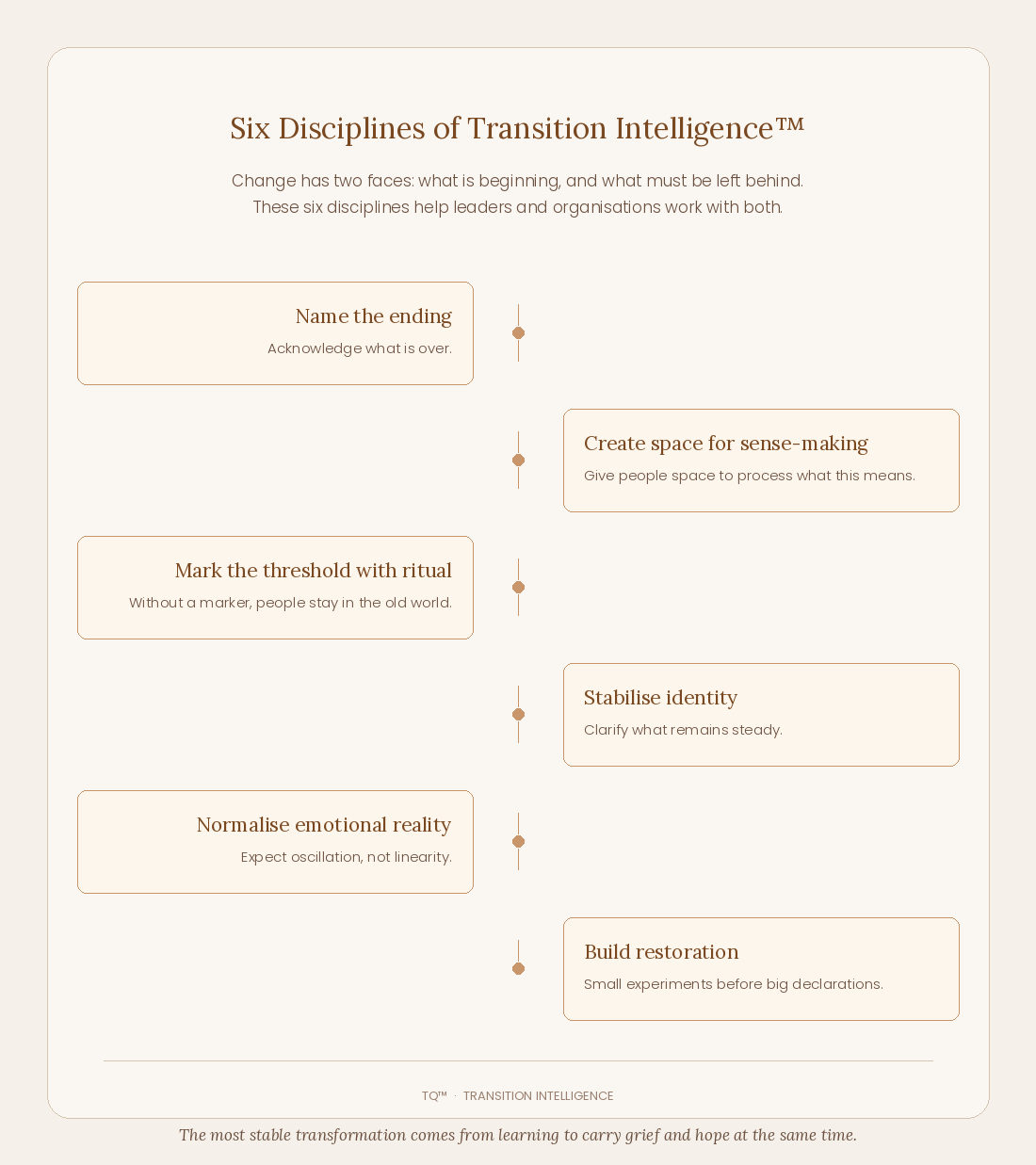
The most stable transformation comes from learning to carry grief and hope at the same time
Who is this for?
Transition Intelligence™ is useful wherever change looks workable on the surface but proves harder to embed in practice - where progress is slowing, alignment is fragile, or execution is starting to distort.
For leaders and professionalsOften the work begins when someone is succeeding externally but feels less settled internally than they expected. This work supports:
Role transitions and the identity shifts that come with them
Identity recalibration - ensuring your sense of self remains stable when the professional context is in flux
Political or relational complexity
Confidence, authority, and decision-making under pressure
For organisations and teamsSometimes the issue isn't the strategy. The direction is clear, the people are capable, and the commitment is real. And yet something doesn't quite land. Decisions slow, ownership blurs, the energy that was present at launch fades.
This work supports organisations and teams navigating:
Transformation under pressure
Culture shifts and the leadership behaviour they require
Stakeholder misalignment
Slowing or distorted execution
Change that looks right on paper but feels stuck in practice
The Scorecard
The Transition Intelligence™ Scorecard is a short diagnostic designed to help you see where a transition is well supported and where it may be under strain.
This 3 -5 minute diagnostic is designed to help you surface what you may already sense but haven’t yet named. It offers a practical starting point for your own reflection, or for a more honest conversation with your team.

Explore further
If you'd like to explore this work further, here are some of the ways I support leaders, teams, and organisations through transition.