

The Belonging Gap: Coaching Through Organisational Transition
Organisational change is usually a journey forward.
There is a vision, a business case, project plan, kick off events. Leaders communicate where the organisation is going and why. Energy is directed towards implementation, engagement and delivery. Always forward.
After more than twenty years working with organisations undergoing transformation, I've noticed a recurring pattern; while organisations are understandably focused on the future, the people expected to deliver that future are often still making sense of what has changed not only operationally, but psychologically too.
Organisational transition rarely asks people simply to learn a new system, report to a different manager or adopt a new way of working. It often asks something much more fundamental. It asks people to reconsider where they belong, what they contribute, how they are recognised, and who they are in this place.
We say 'it's not personal, it's business', but business is as personal as it gets. If you ask someone what they do, they probably won't say: 'I work in medicine.' They'll say: 'I am a doctor.' That word 'am' is identity, not role. And identity does not reorganise itself in the timeframe of a typical transformation plan.
The belonging disruption we don't often name
When we think about belonging at work, we often think about inclusion or exclusion. Transition highlights another dimension.
A restructure, promotion, merger or organisational redesign can unsettle the relationships, identity and familiarity that previously gave someone a sense of place.
The role they understood changes. The team they built no longer exists. The expertise they were known for is no longer central. The informal networks they relied on are disrupted. The new role has been announced, but not yet fully inhabited.
Psychologically, they find themselves in-between. Between a previous identity and an emerging one. Between the belonging they once experienced and the belonging they have not yet rebuilt.
Pauline Boss describes ambiguous loss as loss without clear endings or social recognition. Although developed in clinical contexts, it is familiar in organisational life, where people are often expected to embrace the future, before what has ended has been acknowledged.
By belonging disruption, I mean the psychological disruption that occurs when the people, roles, relationships or structures that anchored their sense of place are altered before new ones have had the opportunity to form. I describe the resulting experience as the Belonging Gap — the space between the belonging that existed and the belonging that has not yet formed.
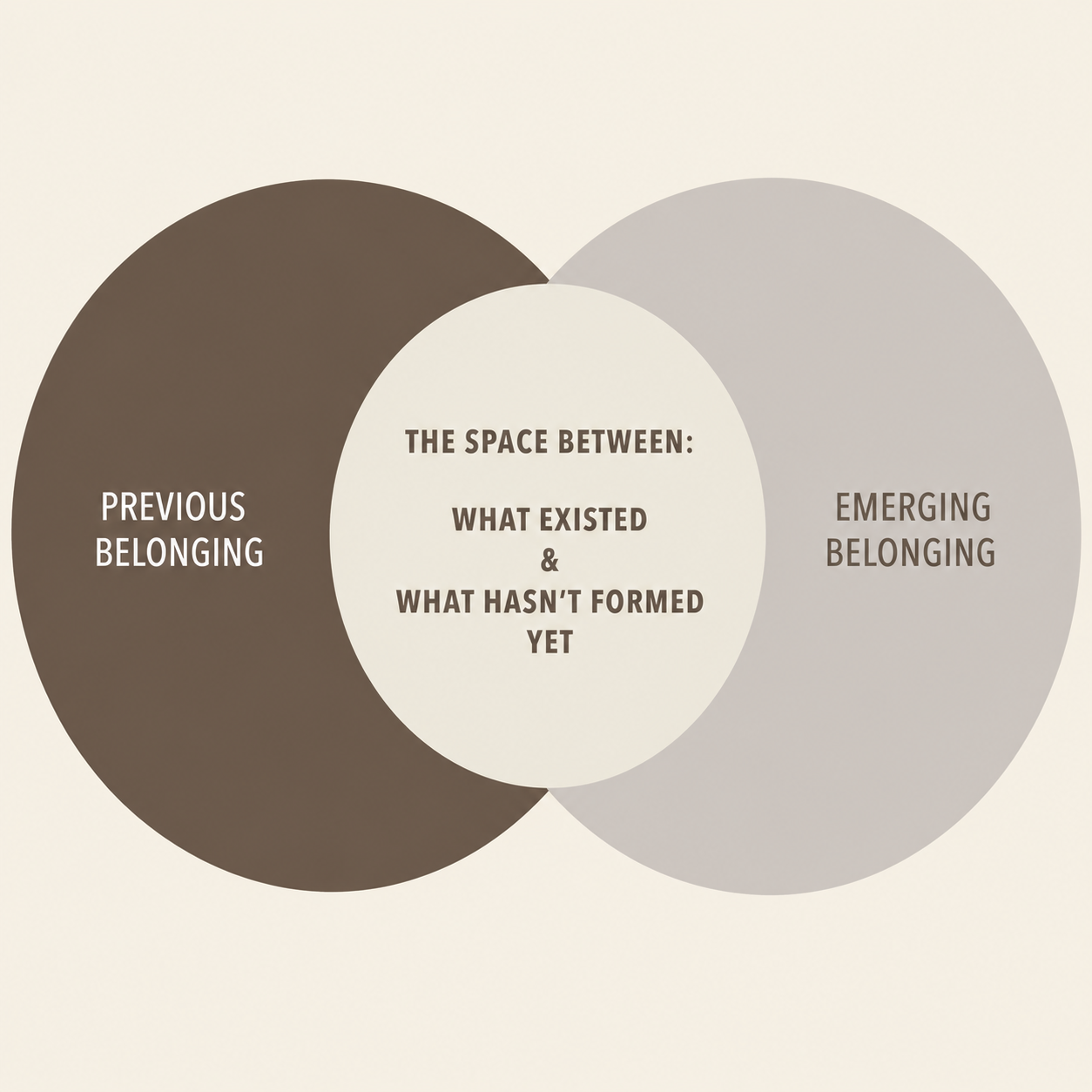
The Belonging Gap
This is not simply uncertainty about tasks or responsibilities. It is often uncertainty about legitimacy, recognition and social safety. Questions such as:
What is expected of me now?
How am I being judged?
Where do I fit?
may sound operational. They are often belonging questions.
When coaching enters the picture
This is frequently the point at which a coach is commissioned to support adaptation and performance. The brief is usually future-oriented: Step into the new role. Sharpen your leadership. Lead the team through change. Manage uncertainty. Perform.
Those are all legitimate goals. At the same time, they create a frame and the frame matters because it shapes what gets contracted, what gets explored, what gets measured and what doesn't get discussed.
A coach operating entirely inside that forward-facing frame risks unintentionally becoming part of the same system dynamic that created the strain in the first place - another voice moving the person forward. If part of the client is still trying to make sense of an ending that was never named, coaching them towards a future they are not yet internally available for risks working on the right outcome at the wrong time. We may be trying very hard, with real skill, to do the right thing wrong.
Coaching's unique contribution
This is where coaching has a distinctive contribution to make. Not because coaching is therapy - it isn't, and that boundary matters. Not because organisational objectives become less important.
But because coaching may be one of the few spaces during organisational transition where the psychological experience of the transition itself can be acknowledged. Where endings can be recognised before futures are demanded. Where oscillation between looking back and looking forward is understood as part of healthy adaptation rather than evidence that someone is failing to move on, or is simply labelled resistant to change.
When that space is genuinely held, something shifts. Self-judgement softens. Curiosity returns. Energy becomes available again. Questions about the future become genuine rather than performed, because the past has finally been given somewhere to exist.
What this might look like in practice
This doesn't necessarily require different coaching models. It may simply require a different stance.
Contracting beyond performance
Alongside the organisational objectives, staying curious about what the transition may have disrupted. What ending is the client navigating that has not yet been acknowledged?
"Alongside thinking about succeeding in this new role, I'd also like us to spend some time understanding what this transition has asked you to leave behind."
Listening for belonging questions
Clients rarely say 'I no longer feel I belong.' Instead it often appears indirectly, through questions about legitimacy, confidence, recognition or place. Listen not only for capability concerns, but for the relational questions beneath them.
"I notice we've come back several times to how you're being perceived. I wonder whether this is less about capability and more about finding your place in this new context."
Legitimising oscillation
Progress during transition is rarely linear. Stroebe and Schut's Dual Process Model reminds us that healthy adaptation involves moving between engaging with the future and acknowledging what has been lost - rather than progressing neatly from one to the other. Naming that movement as normal, rather than as resistance or regression, can shift something significant for a client who may have been privately interpreting their own process as a performance problem.
"Feeling hopeful last week and unexpectedly pulled back into what you've lost today doesn't mean you're moving backwards. It may simply be the work of adaptation."
A final thought
Organisations need people to move forward, fast. The question for coaches is how we hold both the organisational and the individual's needs without becoming another expression of organisational urgency.
If coaching psychology has a distinctive contribution during organisational transition, perhaps it is not simply helping people adapt more quickly. Perhaps it is creating one of the few places where belonging disruption can be recognised, where endings can be acknowledged, and where clients no longer have to pretend they are already fully transformed before they are ready.
This article draws on a paper presented at the Division of Coaching Psychology Conference 2026 and forms part of my ongoing work on Transition Intelligence™, which explores the psychological realities of organisational transition.
