

The Two Faces of Change: Why Vision Alone Fails
In the boardroom, change is almost always painted with a 'happy face.' We frame it as a movement toward something better, bigger, more efficient, or more exciting. We talk about new strategies, revamped structures, and 'opening a new chapter.' We sell the vision because vision is what attracts investment and populates the slide decks of the C-suite. But there is a hidden reality that most leaders ignore at their peril: Meaningful change is also an act of separation.
"Change has two faces: The Vision (the happy face) and the Grief (the sad face). Most organisations overemphasize the vision and wonder why their people are still stuck in the past."
Every new chapter requires the closing of an old one. Every new system requires the death of a familiar process, even if that's the 'devil you know'. In the gap between the vision and the reality lies grief work, the often-ignored 'sad face' of change. When we overemphasize the vision and ignore the loss, we don't get accelerated growth but instead, we get compliance without commitment, or worse, nostalgia disguised as 'constructive challenge.'
If you are a leader focused on EBITDA, performance, and speed, you might be tempted to dismiss this as the 'touchy-feely' people agenda. That would be a mistake. Research, including post-pandemic organizational work by McKinsey, is clear: when loss and emotional disruption are ignored, they don’t disappear. They move underground. They manifest as disengagement, cynicism, fatigue, slow adoption, and quiet withdrawal.
To lead change effectively, we must stop treating emotion as a distraction from the work and start seeing it as the work itself.
The Psychological Truth: Change Begins with an Ending
In psychology, transition theory is unanimous: people move forward most effectively when they are allowed to process both what is beginning and what is ending. Before a new identity can stabilize, something familiar has to be released. This 'something' may be a role, a story, a way of belonging, a sense of certainty, or a specific version of professional competence.
This isn't just about 'bad' change, because even objectively positive transitions carry the weight of loss:
• The Promotion: A career milestone that brings a loss of the peer group and the comfort of established mastery.
• Parenthood: One of life’s greatest adventures, which necessitates a profound loss of autonomy.
• The Career Pivot: An exciting new path that requires the death of a former professional identity and the certainty that came with it.
In the corporate world, we often mislabel the resulting friction as 'resistance.' We assume people are being difficult, political, or stubborn. In reality, they are often simply protecting what still feels psychologically unfinished.
"Change doesn't fail because people hate the future; it fails because they haven't been allowed to say goodbye to the past."
Moving Beyond the "Grief Curve"
For decades, the Kübler-Ross model (the five stages of grief) has been the go-to tool for change managers. While its core premise that movement happens through contact with reality, not around it, is vital, the model is often applied too linearly. Teams don’t move through 'denial' to 'acceptance' in a neat, scheduled row. Expecting individuals to progress through these stages in a straight line is simplistic and, frankly, ineffective.
A more robust framework for the modern workplace is the Dual Process Model (Stroebe & Schut).
The Dual Process Model (DPM) describes how we naturally oscillate between two modes:
1. Loss-Oriented Coping: Grief, remembering, feeling, meaning-making, and honoring what was good.
2. Restoration-Oriented Coping: Figuring out a new role or process, learning something new, and experimenting with the future.
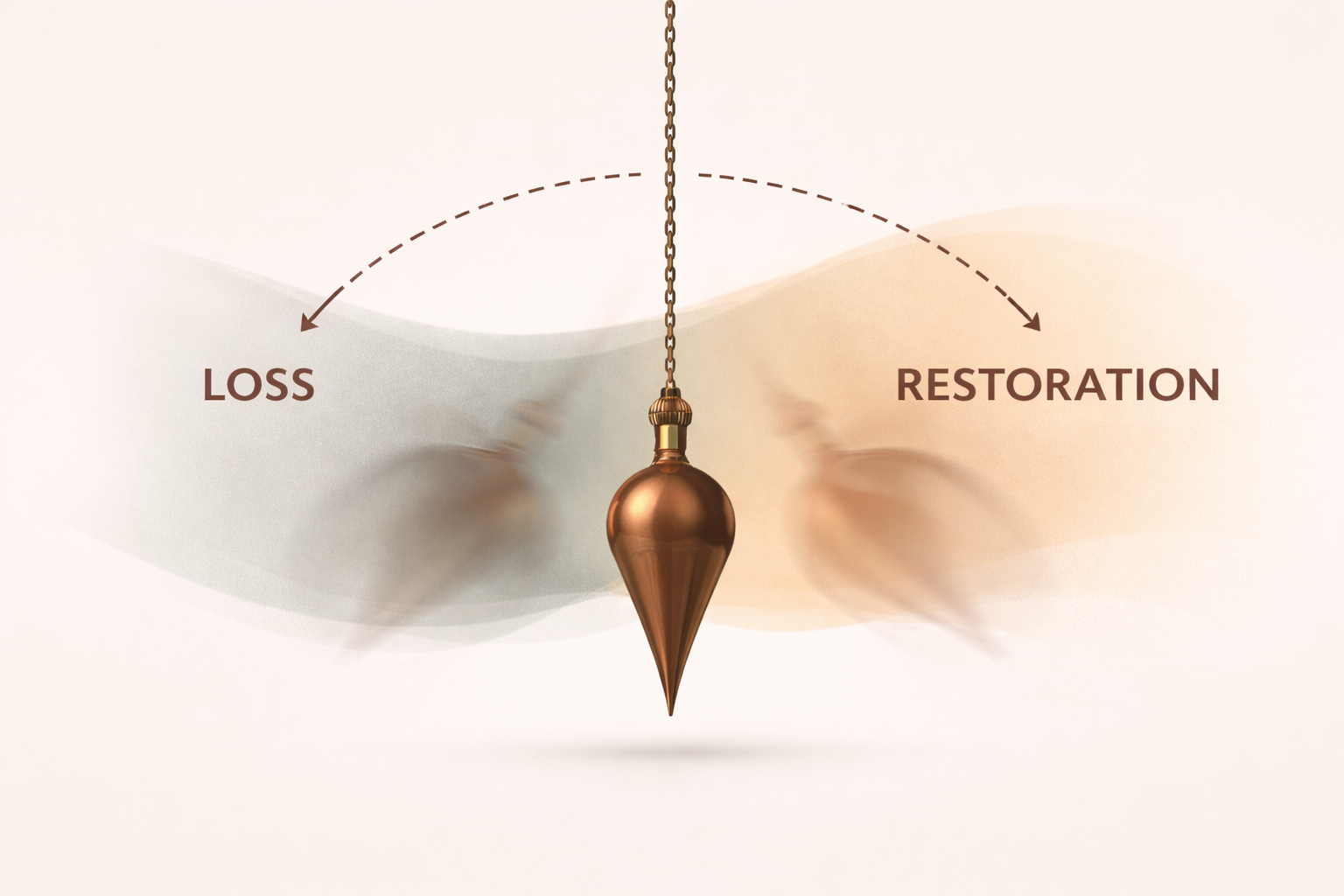
Progress happens because of the movement between the two. This matters enormously for change leadership because it reframes something many misinterpret as failure: feeling hopeful one day and heavy the next is not regression; it is adaptation.
The leadership capability required to navigate this movement is what I refer to as Transition Intelligence™. It is the ability to recognise that every meaningful change contains both a strategic dimension and a psychological one, and to lead people through the oscillation between loss and restoration rather than trying to eliminate it. Leaders with strong Transition Intelligence do not rush people past the ending. They create the conditions for both realities to be acknowledged so that forward movement becomes possible.
The Hidden Reality: Loss Without Closure
Modern life creates a specific kind of psychological difficulty: Ambiguous Loss, a term coined by Pauline Boss. This is loss without a clear ending or a clean break. We see it in:
• Relationships that fade without explanation.
• Career paths that disappear rather than ending cleanly.
• Organizational cultures that dissolve slowly over time.
Humans crave closure, but modern change rarely provides it. This makes the psychological burden of change heavier than we acknowledge. Instead of 'getting over it,' people need to build meaning without resolution, a task that is far harder than simply following a new standard operating procedure (SOP).
Where Growth Actually Comes From
Post-traumatic growth research offers a powerful nuance: Growth is not the opposite of pain. Growth often emerges through the pain of identity reconstruction and values clarification. In other words, the 'happy face' of change is often built using the material of the 'sad face’ and not instead of it.
“Feeling hopeful on Monday and heavy on Tuesday isn't a performance failure - it’s cognitive recalibration.”
The 6-Pillar Framework - Transition Intelligence™ (TQ)
If change requires both loss processing and future building, then mature change leadership must include these six practical pillars.
1. Name the Ending
This is the most avoided step in leadership. Before launching into benefits, leaders must articulate what is actually over.
• Practical Step: Include a 'What We Are Letting Go Of' slide in major announcements. Have senior leaders say: “Some of you may feel disappointed and that makes sense.” That single sentence can reduce defensive resistance more than any 'synergy' speech.
2. Create Structured Space for Sense-Making
Unprocessed change becomes corridor conversation. People don’t resist change; they resist meaninglessness. As Karl Weick’s work on sense-making shows, people need a container to metabolize what this means for them.
• Practical Step: Facilitate small-group conversations within 2–3 weeks of an announcement. Ask: "What feels unclear? What feels like a loss? What might be an opportunity?" Capture these themes visibly.
3. Mark the Ending with a Ritual
Anthropology shows that rituals help people cross thresholds. Without a marker, people psychologically stay in the old world.
• Practical Step: Host a closing event for a discontinued team or product. Tell the story of what was achieved and publicly thank those affected. This prevents silent resentment and preserves dignity.
4. Stabilize Identity Before Selling the Future
During change, identity threat is high. People wonder if they still belong or if their skills are still relevant. Research on Social Identity Theory (Henri Tajfel) suggests that group continuity matters deeply.
• Practical Step: Clarify what remains stable—core values, non-negotiables, cultural anchors. Explicitly state: “Here is what is not changing.” This reduces survival anxiety.
5. Normalise Emotional Reality
Expect oscillation. People will move forward, then revisit loss, then move forward again.
• Practical Step: Stop using the language of "getting on the bus." Instead, acknowledge that a mix of emotions is normal. This isn't "everyone is upset"; it’s "everyone is processing."
6. Build Restoration Fast (But Not Instead of Loss Work)
Capability building will land better than slogans. Small experiments are better than big declarations.
• Practical Step: Give people permission to learn. Focus on building the muscle memory of the new system in low-stakes environments before ramping up performance pressure.
An Honest Relationship with Change
We often talk about optimism as the goal of change. But psychologically, something more stable exists: Integrity.
Integrity in the face of change means telling the truth about what is being lost while still participating in what is being built. This isn't about toxic positivity, and it isn't permanent grief. It is psychological honesty.
When change is happening around you, or inside you, the most useful question is not, "Is this good or bad?" It is:
"What is ending, what is becoming possible, and how do I make space for both?"
Making space for the 'sad face' of change isn't just simply a nice thing to do. For the senior leader with KPIs and targets on the line, it is the only way to ensure the organisation actually performs. The most stable transformation comes from learning to carry grief and hope at the same time.
“People don’t resist change. They resist the meaninglessness that occurs when you skip the grief work.”
If you are currently navigating a significant organisational transition, it may be useful to pause and assess where your change effort is currently focused.
Is the emphasis primarily on vision and strategy?
Or are you also acknowledging the endings people are experiencing?
To support that reflection, I have developed a short Transition Intelligence™ Scorecard, a simple diagnostic based on the six pillars described above.
